During the design and volume take-off process for industrial pumping station systems, mechanical and electrical engineers (MEP) are not only interested in pressure head or flow, but also pay special attention to the problem of optimizing operating costs (OPEX). To solve this problem, the European Union has applied the index MEI (Minimum Efficiency Index) to measure the energy efficiency of the pump.
In the Vietnamese market, the horizontal axis centrifugal pump line Ebara GS is emerging as a leading solution by not only meeting but exceeding this rigorous MEI standard. So what is the technical mystery behind the massive cast iron blocks that help the Ebara GS achieve such groundbreaking flow performance?
1. What is the MEI index and why is it important?
MEI (Minimum Efficiency Index) is the minimum performance index issued by the European Ecodesign Directive (ErP Directive). It evaluates pump performance at three critical operating points:
- Best Efficiency Point (BEP – Best Efficiency Point).
- Part load point (Part load – 75% of BEP flow).
- Overload point (Over load – 110% of BEP traffic).
According to regulations, current industrial pumps must meet this level MEI ≥ 0.4. However, with outstanding improvements in mechanical manufacturing techniques, the Ebara GS pump series has successfully reached and exceeded this threshold, maintaining an extremely stable performance curve.
2. Mechanical engineering: The key to Ebara GS’s performance breakthrough
To achieve the ideal MEI, Ebara did not simply increase engine power, but intervened deeply in geometric design and hydraulic machining techniques:
- 3D Inverse Design Technology: Different from the traditional trial and error method, Ebara applies 3D flow analysis software to accurately simulate the pressure distribution and velocity boundary of water. From there, the company reverse-engineered the profile of the pump impeller (Impeller) and spiral chamber (Volute Casing). The 3D spatial geometry of the impeller is perfectly beveled to help eliminate vortex points, minimizing hydraulic friction.
- Optimize the discharge chamber and cutting blade (Cutwater): The mechanical clearance between the outer diameter of the impeller and the blade in the spiral chamber is finely tuned to the thousandth of a millimeter level. This helps the flow leaving the impeller convert kinetic energy into pressure energy in the smoothest way, limiting sudden pressure drops and cavitation at high flow ranges.
- Precision molding – Super smooth surface: Head loss due to surface friction is the enemy of efficiency. The pump chamber details of the Ebara GS are cast using modern sand mold technology, providing an extremely smooth inner wall surface. The combination of high-strength solid cast iron (or optional brass/stainless steel blades) and precision CNC machining helps the water flow with minimal resistance.
- Static Coaxial and Perfect Dynamic Balance: The pump shaft is machined from monolithic stainless steel, ensuring absolute mechanical rigidity. The mass and center of gravity of the impeller are dynamically balanced on a computer, eliminating vibration during high-speed rotation (2900 rpm). The quieter the machine runs, the less energy is wasted in the form of heat and vibration, thereby pushing the MEI index to the maximum.
3. Actual value brought to key projects
Ebara GS’s mechanical breakthrough brings measurable benefits to investors and general contractors:
- Energy saving: When combined with a standard high-efficiency motor (IE3), the Ebara GS pump cluster helps significantly reduce monthly electricity costs for HVAC systems, cooling towers, or factory water supply stations.
- Extend system life: The machine operates smoothly, without hydraulic turbulence, which will help reduce the load on the bearing system and mechanical seal, thereby reducing costs and frequency of maintenance.
- High reliability: Ensures stable characteristic curves, easily passing strict acceptance tests of the Fire Police (for fire pump applications) or green building standards (LEED, LOTUS).
The intersection of Japanese mechanical heritage and the most rigorous European standards has created a generation of Ebara GS pumps that are flawless inside and out.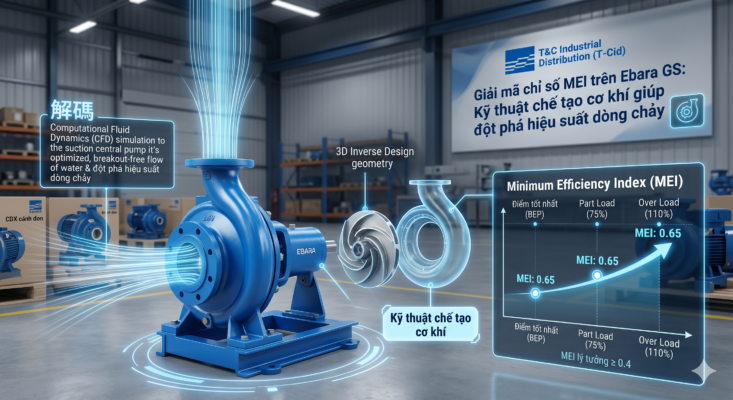
T&C Industrial Distribution (T-Cid) Proud to be the official distributor of Ebara pump solutions, providing contractors and electromechanical engineers with accurate volume take-off advice and the most optimal solution for each flow system.