
In the world of industrial pumping equipment, especially Ebara pumps famous for their durability, “cavitation” or “cavitation” is still a scary ghost, silently wreaking havoc from the inside. This is not just a dry technical problem but is the number one enemy that can turn a powerful Ebara pump into a weak one and eventually completely fail in just a short time.
This article will delve into this dangerous “disease”, decoding the cause and most importantly, providing an effective “treatment” and “prevention” regimen to protect your Ebara pumps.
Cavitation Phenomenon: Causes of Ebara Pump Impeller Failure and How to Fix It
1. What is the phenomenon of erosion? The Scary Nature of Hydraulics
Although it may sound far-fetched, cavitation is actually a simple but devastating hydraulic process. Imagine you are in the pump chamber of an Ebara pump, where water is being circulated at extremely high speeds.
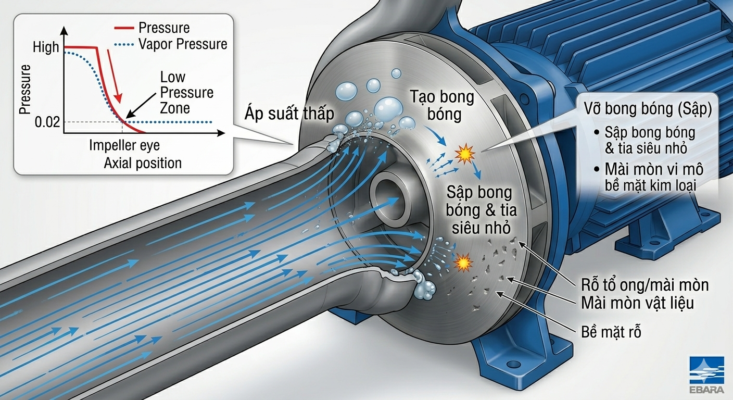
Nature:At some specific point inside the pump chamber, usually at the inlet of the impeller (where water is “sucked in”), the liquid pressure can drop below the vapor pressure (saturation pressure) of the liquid at that temperature. When this happens, the water will “boil” immediately, but not because of the temperature but because the pressure is too low.
Harmful effects caused by “boiling”:
-
Create bubbles:Thousands of tiny vapor bubbles form instantly in the liquid stream.
-
Bubble Burst (Collapse):As the fluid flow moves to areas of higher pressure (inside the pump impeller or outlet), the pressure outside the vapor bubble is much higher than the pressure inside. The bubble will ruthlessly “collapse” inward, creating “micro-jets” of water at super fast speeds (up to 1000 m/s) that shoot straight into the pump impeller surface.
-
Abrasion process:The impact of these water jets repeats millions of times per second, causing extremely large impact forces, gradually “eroding” the metal surface of the pump impeller, creating honeycomb-like pits.
2. Why is the Ebara Pump Impeller a “Bright” Victim?
The Ebara pump line is famous for its premium materials, from seasoned cast iron to perfectly polished 304/316L stainless steel (as on the 3M or Matrix lines). So why are they susceptible to erosion?
There is a bitter truth: Material quality cannot prevent cavitation.Stainless steel can resist chemical corrosion, but under the destructive physical force of millions of microscopic water jets repeatedly impacting, it will also be “peeled” layer by layer.
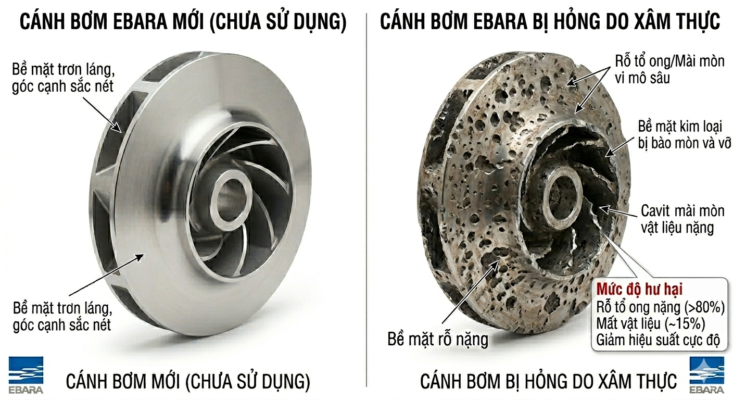
A damaged Ebara pump impeller will have the following symptoms:
-
Deep honeycomb:The surface of the pump impeller is rough, with countless deep pits appearing, as if gnawed by mice.
-
Cracked and broken:At severe levels, pitting weakens the pump impeller structure, leading to cracking or complete rupture, which can cause the pump to jam.
-
Performance reduction:Damaged pump impellers disturb the flow, significantly reducing flow and pressure head compared to design parameters.
3. “Catching Disease” The Main Causes Of Cavitation
Below are common causes, from system design to operation:
a. Low NPSHa Index (Weak “Supply” Disease)
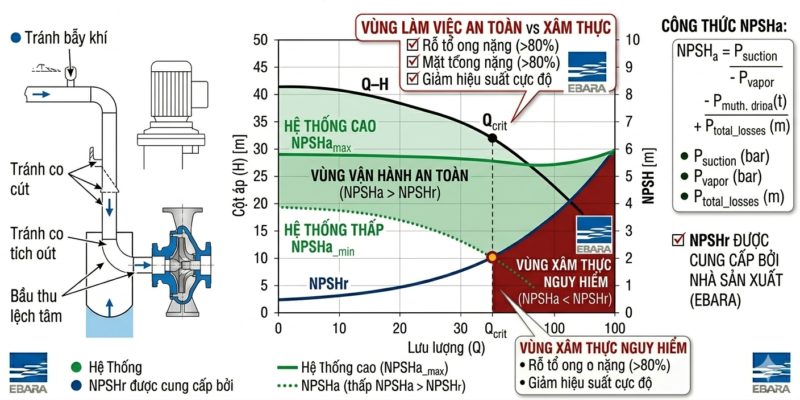
Net Positive Suction Head available (NPSHa)is the total positive pressure at the pump chamber inlet minus the vapor pressure of the liquid. This is the pressure “supply” for the pump.
-
Cause:
-
The suction tank is too low compared to the pump (suction head is too large).
-
Suction pipe is too small or too long.
-
Many accessories (elbows, valves) on the suction pipe.
-
The pump barrel is clogged, creating additional resistance.
-
Fluid temperature too high (vapor pressure increased).
-
b. High NPSHr Index (Excessive Pump “Demand” Disease)
Net Positive Suction Head required (NPSHr)is an index published by Ebara Corporation, representing the minimum pressure level that the pump “requires” at the inlet to avoid cavitation.
-
Cause:
-
The pump operates too far to the right of the characteristic curve (flow rate is too large for design), where NPSHr increases very rapidly.
-
Pump operates at too high a speed.
-
c. Operating at the Wrong Working Point (Illness due to “Operating” in the wrong direction)
Every Ebara pump has a “Best Efficiency Point” (BEP). Operating in this area, NPSHr is the lowest. When the pump operates too far from the BEP area (flow is too large or too small), NPSHr increases, causing NPSHa to easily drop below the necessary level.
d. Poorly Designed Suction Pipeline (Due to Improper “Arrangement”)
-
The elbow is placed too close to the pump chamber inlet, creating strong turbulence and turbulence before entering the pump impeller.
-
The suction pipe system is arranged to create an “air trap”, leading air into the pump chamber.
4. Effective “Treatment” and “Prevention” Regimen for Cavitation
Once we have identified the “disease”, we need to apply measures from design to operation:
4.1. Solution for Suction Piping Systems (Advanced “Bow”)
This is the most important and most effective group of solutions to improve NPSHa:
-
Increase suction pipe diameter:A larger diameter class (e.g. DN100 instead of DN80) can greatly reduce along-line pressure loss and local losses. TCID Tips:Always prioritize the suction pipe 1 level larger than the pump nozzle (DN65 for DN50 suction nozzle).
-
Shorten the suction pipe:Minimize length and number of accessories. Pump as close to the water source as possible.
-
Lower the pump location:If possible, lower the pump position to reduce suction head and increase inlet static pressure.
-
Install appropriate pump gabions and filter mesh:Make sure the filter mesh has a large enough clearance area to avoid clogging. Check the pump basket periodically to remove debris.
-
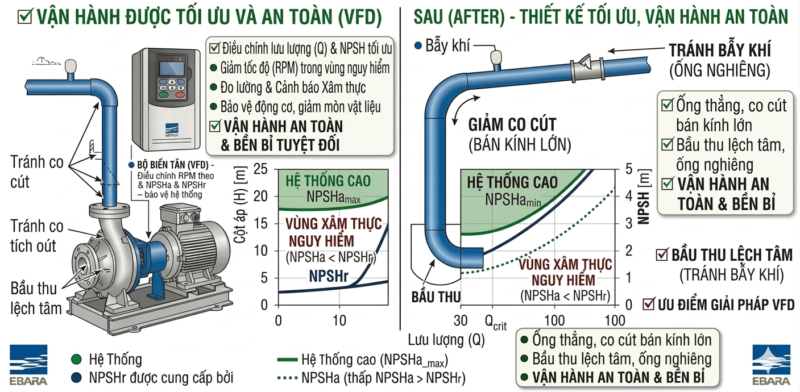
Avoid turbulent flow:Make sure there is a minimum straight section of pipe (about 5-10 times the pipe diameter) directly in front of the pump nozzle. Avoid placing accessories and connectors too close to the pump chamber.
-
Check and prevent “air traps”:Arrange the suction pipe to tilt up towards the pump or install automatic air release valves at high points.
4.2. Solutions From Pump & Motor Side (Improve “Yourself”)
-
Using inverter:If the required flow is regularly less than the pump’s design flow, use an inverter. Pump speed decreases $\rightarrow$ NPSHr decreases and the pressure loss on the pipeline also decreases. This is a “dual effect” solution.
-
Traffic restriction:If the pump is operating too far to the right of the curve (Q is too large), close the discharge valve slightly or increase the discharge pipe resistance. This will reduce flow and lower the pump’s NPSHr.
-
Install the inlet pressure sensor:Integrated inlet pressure sensor to measure NPSHa and set alarm/stop pump when pressure is too low.
-
Irrigation with cooling water (with hot water):If pumping hot water, consider a system that sprinkles cooling water directly into the suction head to reduce local temperatures and lower vapor pressure.
Conclusion
“Cavitation” can destroy an Ebara pump in a very short time if not detected and treated. It is not just a dry technical problem but a “pain” in terms of costs, from electricity bills, money to replace new pump impellers, to production interruptions.
TCID is committed to working with you to protect your Ebara pumping system from this threat. By understanding the nature, causes and applying solutions from design to operation, you can turn your Ebara pump into a true, durable and effective “warrior”.
T&C INDUSTRIAL DISTRIBUTION JOINT STOCK COMPANY (TCID)
Hotline: 090 307 1804
HANOI OFFICE– Address: 6A Lane 49 To Ngoc Van, Tay Ho, Hanoi
HCMC OFFICE– Address: 384/42 Nam Ky Khoi Nghia, Xuan Hoa Ward, City. HCM
Website: https://ebaravietnam.vn/